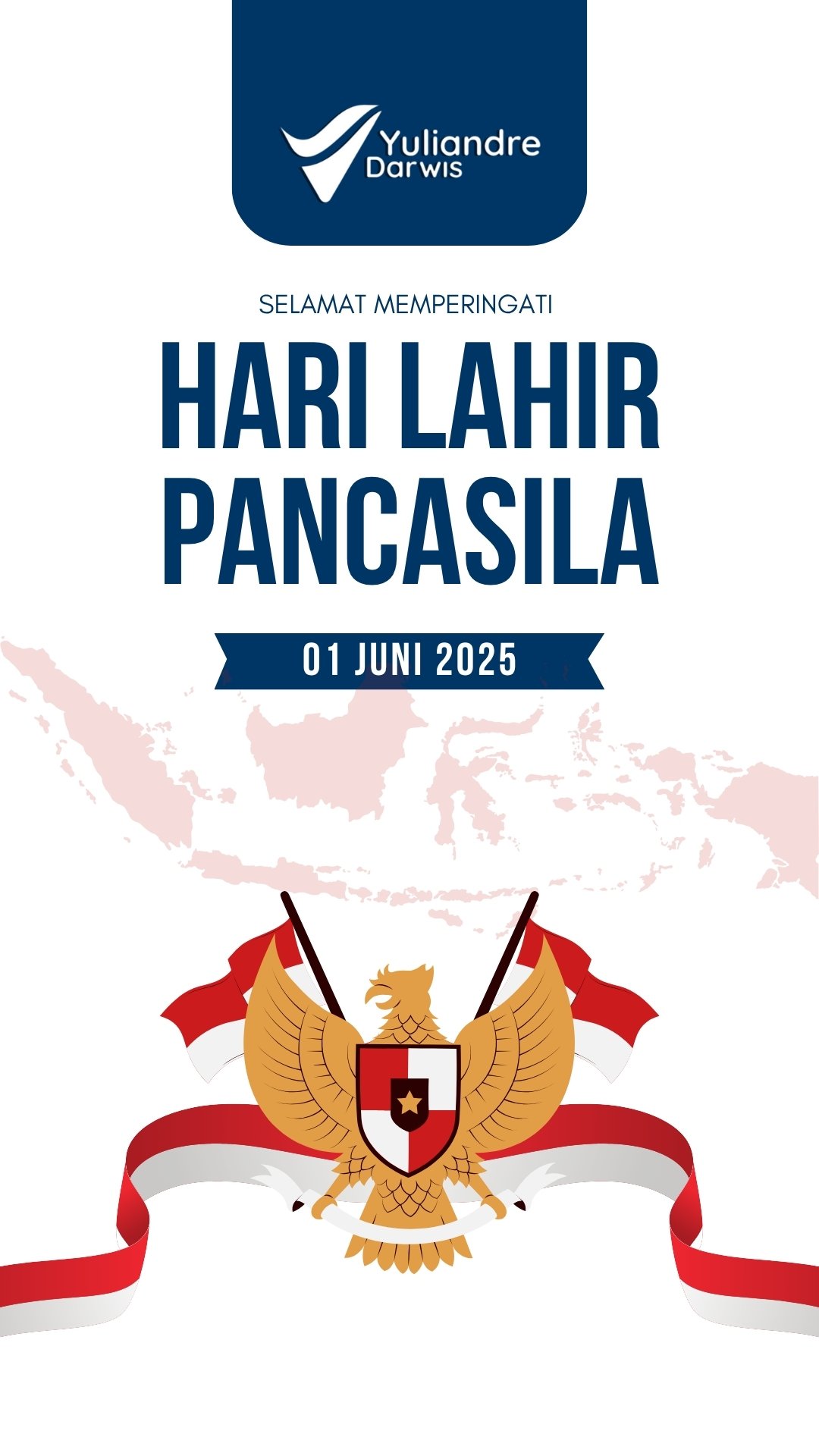
Every 1 June, the Indonesian nation commemorates the Birth of Pancasila. Amid the strong current of digital information, our main challenge is not only to safeguard the ideology but also to communicate it in a way that is relevant, inclusive and down to earth. An ideology that is not communicated in a way that touches people’s hearts will, in time, begin to feel foreign and may even lose its meaning.
As a son of Minangkabau, I believe that Pancasila is not just a national inheritance but is also in harmony with the values of our customary principle, adat basandi syarak, syarak basandi Kitabullah (custom is based on religious law, and religious law is based on the Book of God). The concept of “raso jo pareso” (feeling and judgement) in our culture is in essence a living expression of values such as humanity, deliberation and social justice, three principles that are increasingly tested amid public communication that tends to be complicated and polarised.
Today we live in the age of algorithms, no longer the age of ideology. Viral narratives are more often determined by emotion than by the substance of values. Our task as communicators of the nation is therefore to repackage Pancasila in a language that the digital generation can understand, without losing the depth of its meaning. Not with jargon but with stories; not with posters but with empathy.
In the land of Minang, oral heritage such as kaba, tambo, and the proverbial verses of petatah-petitih is a clear example that communication with value does not always have to be modern. We can use this heritage as a down-to-earth, popular medium for ideological education.
The creative industries in West Sumatra, including local film communities, podcasts and young content creators, have a great opportunity to make Pancasila the soul of their narratives. Content about the nation does not have to be rigid; as long as it is honest and authentic, it will surely live. This is what I call flexible ideological communication, not merely theory.
The moment of the Birth of Pancasila should not be only for repeating grand speeches. It should be a call to bring Pancasila down to earth in creative and contextual ways, including from Minangkabau for Indonesia.
For in raso jo pareso we learn that values are instilled not only through words but also through feeling. And that feeling grows only when our communication touches cultural roots, social roots and the roots of nationhood itself.